
See the concepts in context
Our articles connect individual terms into realistic attack, detection, and response chains.
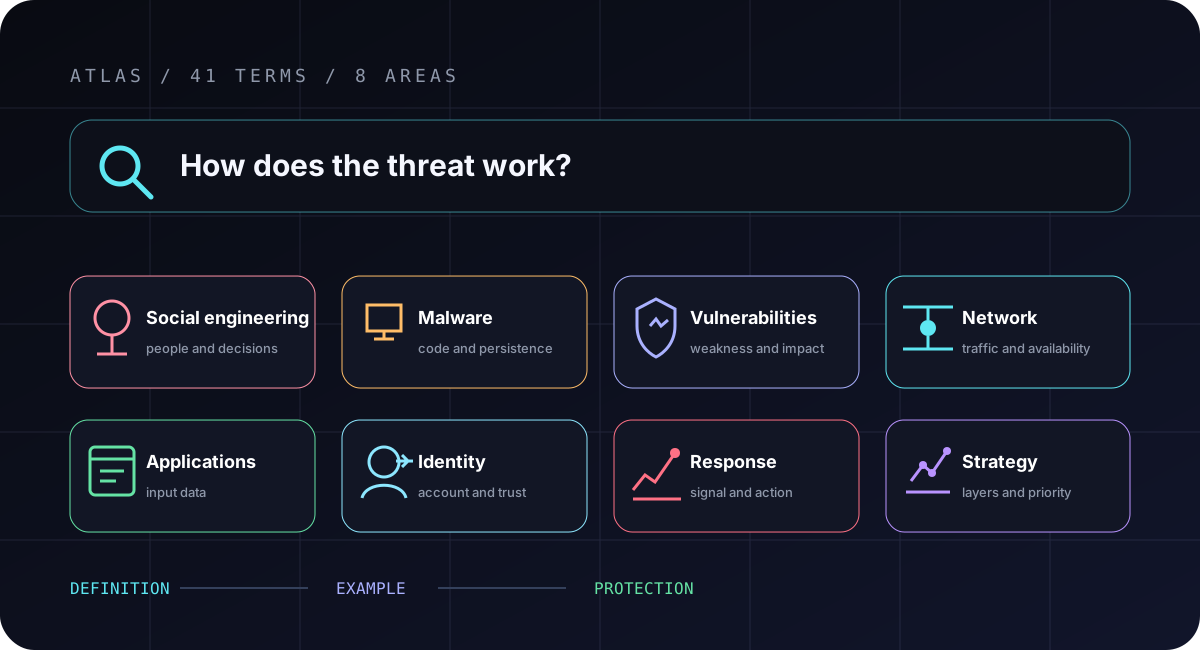
Search for a term or choose a category. Every definition explains the mechanism, gives a realistic example, and identifies the first layer of protection.
Electronic social engineering designed to make a recipient disclose information, open a file, install software, or approve an operation.
Example: an account-lockout message leads to a page that imitates the legitimate login panel.
Protection: open the service independently, verify the request through another channel, and use phishing-resistant MFA.
An attack tailored to a specific person, organization, or industry using genuine contextual information.
Example: a fabricated request to accounting refers to a real supplier and a current project.
Protection: independently confirm financial changes and make suspicious messages easy to report.
A form of spear phishing aimed at executives, owners, directors, or people with extensive privileges.
Example: a CEO receives a convincing legal notice containing a link designed to compromise a Microsoft 365 account.
Protection: strong authentication, additional transaction approval, and role-specific training.
A text message that urges the recipient to open a link, disclose information, or contact fraudulent support.
Example: a message about a small parcel surcharge leads to a fake payment gateway.
Protection: do not use the link in the message; open the provider's official service independently.
Manipulation conducted through a phone call or voice message.
Example: someone claiming to represent a bank demands installation of remote-access software to “protect the funds.”
Protection: end the call and independently dial the institution's official number.
Malicious code that attaches itself to a file or program and replicates when that host is executed.
Example: an infected document modifies additional files belonging to the user.
Protection: updates, controlled execution, EDR or antimalware, and limited privileges.
A malicious program that pretends to be legitimate or useful. Unlike a virus, it does not have to infect additional files by itself.
Example: a fake application installer also launches a password-stealing tool.
Protection: install software from verified sources and check file signatures and reputation.
Malware capable of spreading between systems on its own, often through networks and vulnerable services.
Example: a worm exploits the same flaw on successive unpatched hosts.
Protection: rapid patching, segmentation, and removal of unnecessary services.
Malware that blocks access to data or systems, often combined with information theft and a threat to publish it.
Example: after moving laterally, an attacker encrypts servers and removes accessible online backups.
Protection: segmentation, resilient backups, MFA, EDR, and a rehearsed incident procedure.
A set of techniques or code used to conceal processes, files, or attacker access, often at a highly privileged system layer.
Example: a malicious driver hides a process and its network connection.
Protection: Secure Boot, driver controls, EDR, and restoration from a trusted image after confirmation.
A mechanism that bypasses normal authentication or provides covert access to a system.
Example: an additional administrative account created after compromise.
Protection: change control, monitoring of accounts and services, and persistence analysis.
A group of infected devices controlled together by an operator of criminal infrastructure.
Example: thousands of compromised routers send traffic to one service simultaneously.
Protection: replace default credentials, update firmware, and monitor communications.
A weakness in software, configuration, process, or design that can be exploited to compromise security.
Example: missing authorization checks let one user read another user's document.
Protection: secure design, testing, patch management, and layered controls that limit impact.
A method of making a vulnerable system behave in an unintended way.
Example: a specially crafted request causes a server to execute a command.
Protection: remove the vulnerability, control exposure, and add mechanisms that obstruct exploitation.
The part of an attack that produces the intended effect after the attacker gains the ability to act.
Example: an exploit opens the path, while the payload creates a remote session or downloads another module.
Protection: block the vector, control applications, use EDR, and limit process privileges.
A vulnerability exploited before an effective patch is available or before defenders know enough to deploy protection.
Example: a newly discovered flaw in a VPN gateway is actively exploited before a patch is released.
Protection: segmentation, least privilege, behavioral monitoring, and the ability to reduce exposure quickly.
A standard identifier for a publicly disclosed vulnerability, allowing different sources to refer to the same issue.
Example: a vendor and a scanner use a CVE number to identify a specific flaw.
Protection: the identifier alone does not determine organizational risk; verify the version, exposure, and actual impact.
A system for describing the technical characteristics and severity of a vulnerability. It supports comparison but does not replace business context.
Example: a high score may not mean highest priority when the vulnerable component cannot be reached.
Protection: combine CVSS with exposure, asset value, active exploitation, and existing controls.
An attempt to disrupt a service by exhausting resources or exploiting a flaw, usually from a limited number of sources.
Example: a stream of expensive requests overloads one application process.
Protection: rate limits, queues, resource isolation, monitoring, and resilient architecture.
A distributed DoS launched simultaneously from many devices or networks, making simple blocking of one source ineffective.
Example: a botnet generates more traffic than the organization's connection can carry.
Protection: carrier or CDN mitigation, upstream filtering, an escalation plan, and tested failover architecture.
An attacker positions themselves between communicating parties to observe or modify the traffic.
Example: a rogue Wi-Fi access point attempts to intercept user traffic.
Protection: correct TLS, certificate validation, secure Wi-Fi, and a VPN on risky networks.
An IDS detects suspicious activity, while an IPS can additionally attempt to block it in the traffic path.
Example: the system alerts on a network request that matches an exploitation pattern.
Protection: current rules, correct placement, and an alert-handling process matter as much as the appliance itself.
A vulnerability that allows code to be introduced and executed in another user's browser within the context of a trusted website.
Example: a comment contains a script that runs when someone opens the panel.
Protection: context-aware output encoding, validation, CSP, and secure cookies.
An unsafe combination of user-controlled data and a database query that lets the data change the query's meaning.
Example: a search parameter alters a condition and exposes another user's records.
Protection: parameterized queries, minimal database privileges, and access-control testing.
A vulnerability that allows an attacker to make a server send a request to a chosen or indirectly controlled destination.
Example: an image-fetching feature reaches an internal service that is not visible from the Internet.
Protection: destination allowlists, a safe resolver, internal-address blocking, and egress controls.
The ability to execute code or commands remotely on a vulnerable system.
Example: crafted input causes a server process to run an operating-system command.
Protection: remove the vulnerability, isolate the process, minimize privileges, and restrict outbound communication.
Using a stolen or predictable session token to act as an authenticated user.
Example: an attacker uses a stolen cookie without knowing the victim's password.
Protection: short-lived sessions, secure cookies, token rotation, anomaly detection, and session revocation.
Authentication requiring factors from different categories, such as knowledge, possession, or an inherence factor.
Example: a password plus a hardware key that verifies the legitimate domain.
Protection: prefer phishing-resistant factors; a push notification can still be approved under pressure.
A sign-in mechanism based on public-key cryptography and a credential bound to the correct service.
Example: a user confirms sign-in using device biometrics without typing a password into the website.
Protection: configure secure account recovery; a weak recovery path can bypass strong authentication.
Systematically trying many possible passwords or keys until the correct one is found.
Example: automation tests successive combinations against one account.
Protection: long unique passwords, MFA, rate limiting, delays, and monitoring.
Automated testing of username-password pairs obtained from earlier breaches against other services.
Example: a password leaked by an online shop also works for the user's corporate email.
Protection: unique passwords stored in a manager, MFA, and detection of unusual sign-in attempts.
Obtaining more privileges than were intended for an account or process.
Example: a standard user exploits a flaw to perform an administrator-only function.
Protection: least privilege, role separation, and regular authorization testing.
An observable artifact that may indicate a compromise, such as a file hash, domain, IP address, or registry key.
Example: a process connects to a domain associated with a known malware campaign.
Protection: an IOC needs context and a validity period; one match does not always confirm an incident.
A way of describing an adversary's objectives, techniques, and practical behavior.
Example: a group gains access through phishing, steals a session token, and creates a rule that hides email.
Protection: behavioral detection often lasts longer than blocking individual domains or hashes.
A tool that collects endpoint telemetry, detects suspicious behavior, and supports response actions.
Example: EDR links a document launch to an unusual child process and network connection.
Protection: it requires correct configuration, sufficient retention, and a team able to handle alerts.
A platform that collects and correlates events from many systems for monitoring, detection, and analysis.
Example: it correlates a sign-in from a new country, a mailbox-rule change, and a large file download.
Protection: source quality, time synchronization, and response procedures matter more than log volume alone.
A function or team that monitors security, analyzes alerts, and coordinates incident response.
Example: an analyst connects an EDR alert with identity logs and escalates a confirmed incident.
Protection: a SOC needs clear responsibilities, reliable data, and rehearsed procedures.
Introducing a malicious component or change into a trusted delivery process, such as a library, repository, image, update, or build environment.
Example: a package with a name similar to a popular library executes additional malicious code.
Protection: dependency control, signatures, SBOM, restricted pipeline privileges, and behavioral monitoring of delivered code.
An approach that grants no automatic trust merely because a user or device is located “inside” the network.
Example: access depends on identity, device posture, resource sensitivity, and risk for the specific session.
Protection: strong identity, least privilege, segmentation, and continuous signal evaluation.
An attacker's movement from the initially compromised asset to additional systems and accounts.
Example: after compromising a workstation, the attacker uses stored credentials to reach a file server.
Protection: segmentation, separate administrative accounts, MFA, and detection of unusual relationships between hosts.
The unauthorized transfer of data outside a controlled environment.
Example: an archive of documents is sent through a legitimate cloud service used as an outbound channel.
Protection: data classification, least access, DLP, egress controls, and anomaly monitoring.
Our articles connect individual terms into realistic attack, detection, and response chains.
Tell us where you encountered it. We will extend the glossary with a practical explanation.